

Trending News
The AI Super PACs Trying to Influence the Midterms

This is an edition of The Atlantic Daily, a newsletter that guides you through the biggest stories of the day, helps you discover new ideas, and recommends the best in culture. Sign up for it here.
OpenAI’s CEO signed a letter in 2023 acknowledging that AI might cause human beings to go extinct. More recently, Anthropic’s CEO said that AI will “test us as a species.” Many Americans seem to believe them: A March poll showed that a majority of voters think the risks of the technology outweigh the benefits. Now, as the midterm elections approach, tech-affiliated super PACs are investing tens of millions of dollars to try to overcome that animus.
To understand their strategy, think back just a few short years to a playbook established by the cryptocurrency industry. During the 2024 election cycle, crypto and venture-capital firms poured funds into a super PAC called Fairshake, which spent hundreds of millions of dollars supporting pro-crypto candidates and attempting to undercut anti-crypto candidates. The plan worked. Major politicians (both Republicans and Democrats) supported by Fairshake and its affiliate PACs defeated their opponents; Congress became marginally more accepting of crypto; and the industry notched several major policy wins the following year.
AI-backed super-PAC groups are now adopting Fairshake’s model, but under profoundly different circumstances: About half of American adults say that they use chatbots such as ChatGPT, whereas just under one-fifth say that they’ve used or invested in crypto. AI is both ubiquitous and largely distrusted. No leading candidates are advocating for a ban. Instead, the question is how this industry ought to be regulated.
Two super-PAC groups offer two different answers. One, Leading the Future, which was co-founded by the venture-capital powerhouse Andreessen Horowitz, has embraced a regulation-light approach to AI, focusing on “identifying, maintaining, and growing pro-AI candidates.” It has raised more than $140 million, receiving contributions from the VC firm’s founders as well as OpenAI President Greg Brockman. Leading the Future’s priorities seem to align with those of OpenAI. (The AI firm recently put out a statement distancing itself from the super PAC.)
Meanwhile, OpenAI’s main rival, Anthropic, donated $20 million to the competition: Public First Action, a nonprofit that works with super PACs to back candidates who have a focus on AI safety. (Anthropic has stated that its donation is reserved exclusively for the group’s AI-education initiatives and “cannot be used for federal election activity.”) The group touts its support of comprehensive regulation over the “move fast and break things” approach. It’s in line with how Anthropic has described its priorities—the company has always positioned itself as a humane, safety-focused alternative to first-mover OpenAI and was recently blacklisted by Pete Hegseth’s Department of Defense after it refused to remove guardrails from one of its AI models (the company is currently suing the government). One of Public First Action’s co-founders described it as “the anti-super PAC super PAC”—purely a way to counter Leading the Future and its Donald Trump–aligned donors.
A high-profile battle between the two has been playing out in New York’s Twelfth Congressional District. Alex Bores, one of the leading candidates, is a former Palantir employee who left the company after it renewed its contract with ICE; he’s been running as the candidate who knows how to regulate Big Tech because he understands its power. Leading the Future’s ads have blasted him for his focus on regulation, calling him a “hypocrite” who will stifle AI’s progress. Politico calculates that groups affiliated with the tech industry have spent $26 million to ensure that Bores doesn’t win. Meanwhile, Public First Action and other aligned groups have spent $18 million to back him.
The political strategist Cooper Teboe told me that the New York race “will be viewed as the final exam” for this model of AI-backed political spending. If Leading the Future wins out and Bores loses, the super PAC could double down on its playbook in future races. So far, Leading the Future’s spending has arguably given Bores more attention, and has in some ways bolstered his appeal to AI-critical voters. One of his own campaign ads satirizes an “AI super PAC” with an evil-sounding robot voice that is trying to destroy him; the ad paints Bores as the level-headed alternative.
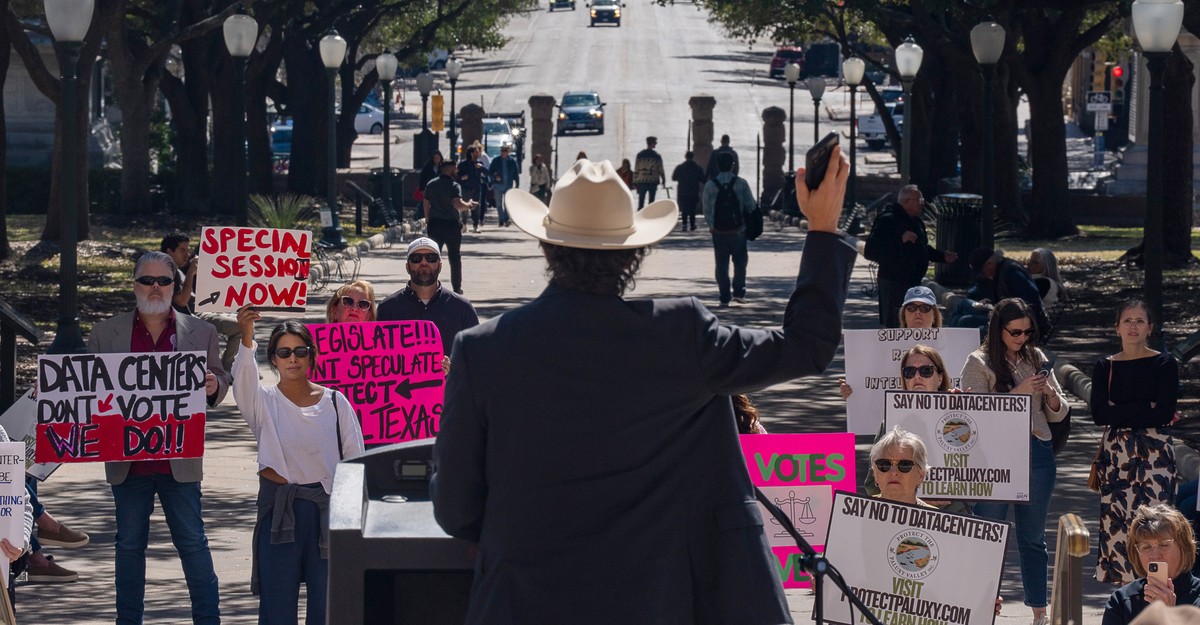
As the midterms approach, debates over AI have intensified. Last month, when commencement speakers at the University of Central Florida, the University of Arizona, and Middle Tennessee State University began to talk about AI’s importance in graduates’ lives, they were met with loud boos. It’s worth watching video clips from the events to get a sense of the ambient feeling; these kids hate AI. People are especially skeptical of data centers: Seven out of 10 Americans don’t want to see one built in their area. And the conversation has lately escalated into violence: Two months ago, an Indiana politician’s home was fired at 13 times, and a handwritten note reading “No Data Centers” was left on his doorstep.
The industry seems to be realizing that supersize personalities such as OpenAI’s Sam Altman and Anthropic’s Dario Amodei, who tend to speak about AI’s potential in extreme terms, aren’t necessarily equipped to represent the tech to worried voters. The fight over AI regulation has the potential to affect nearly everyone in American society. How should AI’s processing power be taxed? Will data centers ultimately subsidize the restoration of the country’s electrical grid? What towns should allow data centers to be built, and which shouldn’t? Voters will decide, but the industry—and its money—will be guiding the conversation.
Related:
Here are three new stories from The Atlantic:
Today’s News
- President Trump and Iranian officials offered conflicting accounts of what will happen to Iran’s nuclear sites; Trump said that Iran had “fully and completely” agreed to allow nuclear inspections, which Tehran denied.
- France recorded its hottest day in history today, as several European countries also face extreme heat levels.
- The Supreme Court ruled that a Rastafarian man could not sue for religious reasons after prison guards shaved off his dreadlocks.
Dispatches
Explore all of our newsletters here.
Evening Read

The Warrior-Witches of Ukraine’s Resistance
By Ken Harbaugh
For several months last year, a Ukrainian housewife, 35 and lonely in a marriage that had gone cold, traded WhatsApp messages with a Chechen commander, Achmad, stationed somewhere in Ukraine’s occupied south. They wrote about their days, their disappointments, what they hoped to do when the war ended. She asked about the front. He told her.
“Send me a picture,” she said. “I want to see your life.”
One afternoon, he obliged—a photograph taken inside the barracks, of himself and another soldier grinning for the camera. Behind them, pinned to the wall, was a map of the compound showing the unit’s position.
More From The Atlantic
Culture Break

Read. Critics of the investigation into the assassination of President John F. Kennedy pioneered an American pastime: obsessing over a document dump. Kaitlyn Tiffany’s new book is about the women who went deep examining the crime.
Watch (or skip). Toy Story 5 (out now in theaters) confronts a nightmare of modern parenting, David Sims writes.
Stephanie Bai contributed to this newsletter.
When you buy a book using a link in this newsletter, we receive a commission. Thank you for supporting The Atlantic.