


Trending News
At least 77 court rulings concerning Trump’s second term include sharp criticism from judges

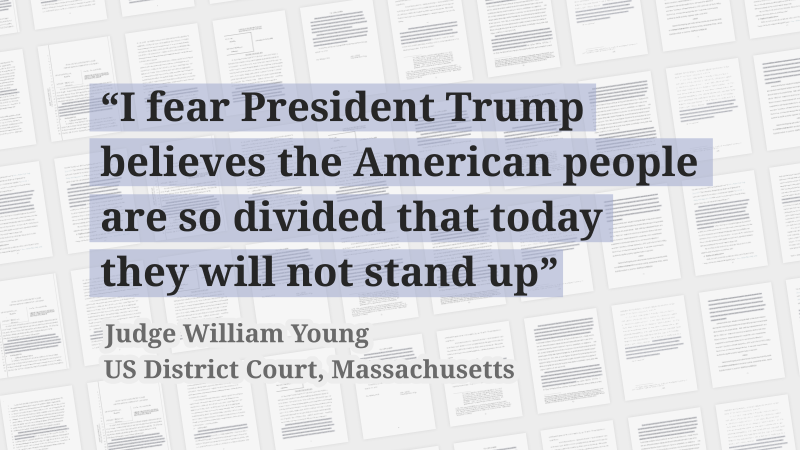
CNN read hundreds of pages of recent federal court rulings involving the Trump administration.
The language judges used to describe the conduct of the administration and its lawyers is extraordinary:
Inside federal courts across the country, institutional alarm is rising from the bench. Judges are using unusually sharp language to push back against what they see as mounting government attacks on the judiciary and the legal system itself.
In the 77 rulings CNN identified, dozens of federal judges appointed by presidents of both parties — including several of President Donald Trump’s appointees — have accused the Trump administration of acting unlawfully, disregarding constitutional limits, retaliating against political opponents and, in some cases, openly defying court orders.
“What we’ve seen over the last 16 months is far above and beyond what we’ve seen before,” said Steve Vladeck, a CNN Supreme Court analyst and law professor at Georgetown University Law Center.
The criticism has been extraordinary, both in terms of its intensity and consistency, Vladeck said. Across dozens of rulings, federal judges have described the government’s actions using scathing language: “squalid,” “irrational,” and “shocking not only to judges, but to the intuitive sense of liberty that Americans far removed from courthouses still hold dear.” The excerpts below offer a sample of their reprimands, drawn from courts across the country and issued by judges of varying backgrounds.
September 30, 2025
“The President’s palpable misunderstanding that the government simply cannot seek retribution for speech he disdains poses a great threat to Americans’ freedom of speech.”
— Judge William Young
March 6, 2025
“An American President is not a king—not even an “elected” one—and his power to remove federal officers and honest civil servants like plaintiff is not absolute but may be constrained in appropriate circumstances.”
— Judge Beryl Howell
January 31, 2026
“The case has its genesis in the ill-conceived and incompetently-implemented government pursuit of daily deportation quotas, apparently even if it requires traumatizing children.”
— Judge Fred Biery
CNN reviewed hundreds of court rulings and media reports to identify 77 cases since the start of Trump’s second term in January 2025 in which judges sharply criticized the administration or federal entities’ policies and their execution. The orders were issued by 69 different judges, more than a third of whom were appointed by Republican presidents, including Trump himself. This analysis is intended to highlight policy criticisms, rather than track cases themselves and is not exhaustive.
Vladeck said such a high number of these cases with this type of criticism is both shocking as a matter of historical precedent but also an undercount based on what he has observed playing out in federal district courts.
Judges by appointing president
Joe Biden 2021-2025

Barack Obama 2009-2017

Bill Clinton 1993-2001

Donald Trump 2017-2021, 2025-present

George W. Bush 2001-2009

Ronald Reagan 1981-1989

Note: Data omits one judge appointed by the Northern District of Illinois (not a president)
While the opinions differed in subject matter, patterns emerged. Critical remarks in judges’ orders and opinions tended to cluster around three types of misconduct: abuse of power, bad-faith behavior, and suspected retaliation. While all 77 cases fell into at least one category, many orders fell into more than one.
The cases CNN identified also spanned some of the administration’s most contentious policy areas, and criticism began almost immediately in Trump’s second term. Rulings tied to executive overreach dominated the earliest months of Trump’s presidency, with judges raising concerns in January 2025, just after his inauguration.
As the year progressed, immigration-related cases surged to become the largest share of rulings identified, with 35 opinions tied to deportations, migrant rights, birthright citizenship and the rights of individuals detained by the government to challenge their detention in court.
The volume spiked significantly in early 2026 in the wake of Operation Metro Surge, the largest immigration enforcement operation in US history, triggering a wave of legal challenges in federal courts across the country. The criticism has not let up, with cases continuing through June 2026.
-

Immigration
-

Free speech
-

Executive overreach
Jan. 2025
1

June
2


Aug.
1

May
2


June
2


The Trump administration in turn is hitting back against the courts.
In a statement to CNN, White House spokesperson Abigail Jackson rejected the criticism highlighted in the rulings, saying that lower-court judges are pushing their own policy goals. She said the administration would continue pursuing its agenda despite “judicial activism.”
While clashes between presidents and the judiciary aren’t uncommon, presidents have generally respected court rulings even as they pursued legal challenges. However, Trump has veered away from modern norms, repeatedly attacking judges publicly while also moving far more aggressively than past presidents to seek Supreme Court intervention.
Those public attacks have targeted judges appointed by presidents of both parties. On Truth Social, Trump derided US District Judge Richard Leon as “Trump Hating” and “out of control,” accusing him of undermining national security. Leon, an appointee of former President George W. Bush, became a focus of Trump’s ire after he blocked the White House ballroom project, ruling that construction must pause until Congress grants authorization. In other instances, he has used social media to call for judges’ impeachments, earning a rare rebuke from Chief Justice John Roberts last year.
While sitting judges generally avoid commenting publicly on political controversies, retired judges have become increasingly vocal in defending judicial independence amid what they see as escalating attacks on the courts. Mark Wolf, a Reagan-appointed federal judge of over 40 years, resigned last November, writing in The Atlantic that the White House’s assault on the rule of law is so deeply disturbing he felt compelled to speak out.
“There have been calls over time for the impeachment of federal judges,” Wolf said in an interview with CNN. “But what’s happening now is unprecedented.”
Federal judges are expected to speak primarily through their hearings and written opinions. They don’t express themselves on social media or TV, Wolf said. Ethics rules and longstanding norms discourage sitting judges from making public statements that could call their impartiality into question, leaving retired judges with greater freedom to engage in broader debates about the courts.
That dynamic is fueling an organized response from former members of the judiciary. The Article III Coalition, a group of retired federal district and circuit judges, was founded last year in May to defend judicial independence and protect the Constitution’s separation of powers.
In response to the attacks on judges, a recent judicial ethics opinion from a committee of the federal judiciary emphasized that judges may publicly defend “judicial independence” and “the rule of law,” including through measured responses to attacks that threaten the courts’ legitimacy.
What is striking and new is the opinion’s clear emphasis at this point in time of the importance of judges speaking out in defense of the rule of law and against those who would seek to undermine it, Vladeck wrote in February.
For some judges, those concerns have taken on particular urgency. Wolf believes the justice system in the United States is facing an existential threat. Public confidence in the courts, he said, depends on the belief that judges can decide cases impartially. In turn, a president’s willingness to respect and comply with court orders depends on the American people’s support for the courts.
“To the extent that the president and his subordinates can violate the law with impunity, including by disobeying court orders, we no longer have the rule of law,” he said.
CNN reviewed cases reported by CNN, AP, Reuters, NPR, The New York Times and The Washington Post that involved judicial policy criticisms since January 20, 2025, through publication. We searched manually and using both Google Gemini AI and a Python web-scraper tool, which searched for the keywords Trump; judge, policy, criticism, rebuke, reprimand and scathing ruling within the aforementioned sources and timeframe. We also asked Google Gemini to review the more than 800 cases filed against the Trump administration tracked by Just Security, a non-partisan law and policy journal at the Reiss Center on Law and Security at New York University School of Law, and to identify cases where judges raised concerns about abuse of power and executive overreach, bad-faith behavior and potential retaliation and discrimination. All cases identified with AI and the Python scraper were independently reviewed and verified. All the cases CNN identified were categorized by the themes in judges’ criticism, all of which fell under either abuse of power, bad-faith behavior, or potential retaliation or discrimination, with several falling under multiple categories. CNN also categorized cases by policy type, all of which fell under immigration, First Amendment protections, executive overreach, or a combination. This project is intended to identify policy criticisms of the Trump administration, rather than track cases themselves; many of these cases have since progressed to the Supreme Court or have been appealed by the Trump administration. This list is almost certainly an undercount and not exhaustive.